



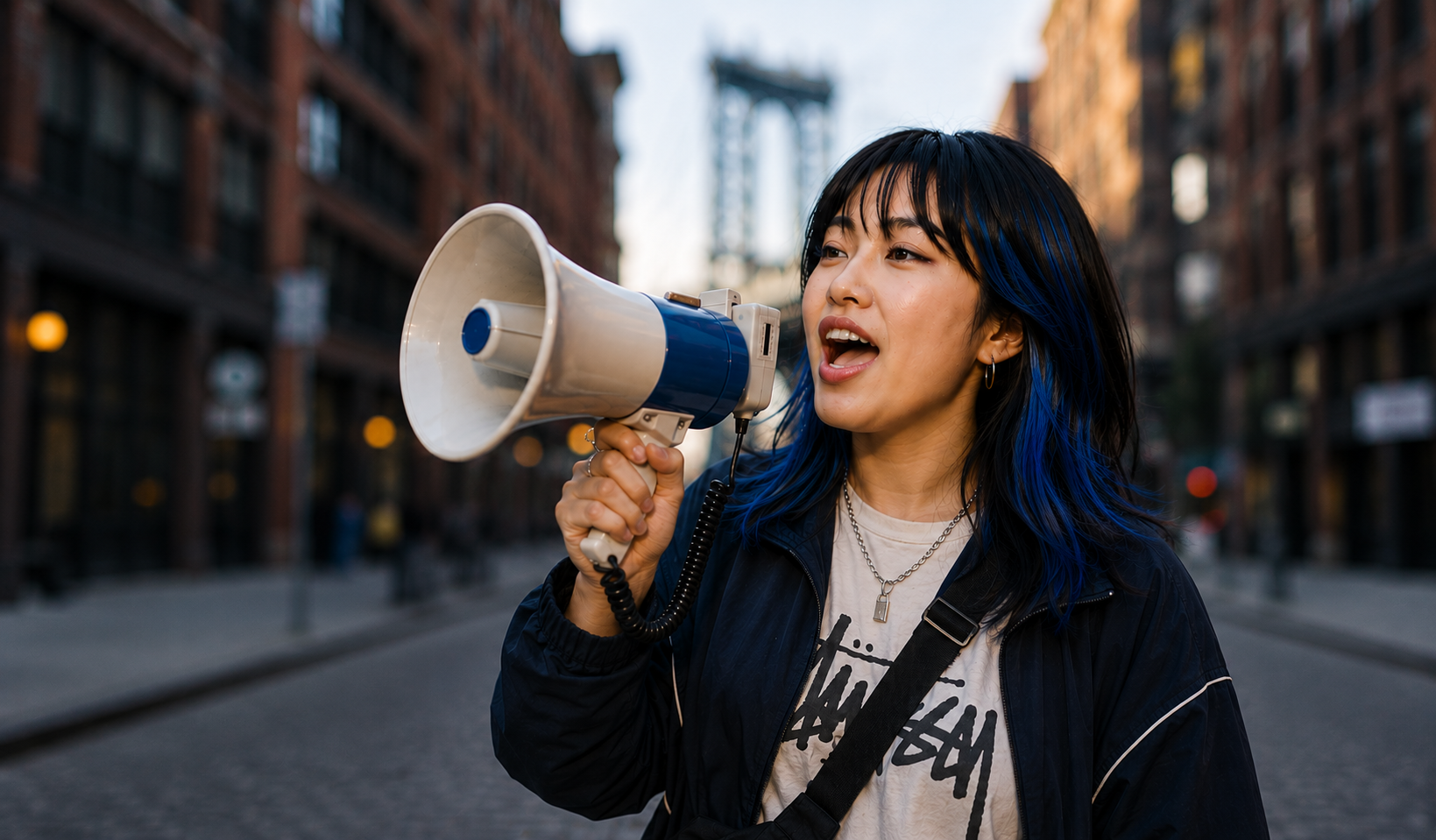
Instagram DM automation for e-commerce is a tool that automatically sends a direct message — a product link, discount code, or order update — the moment a shopper comments a keyword, replies to your story, or DMs your brand.
It runs on Meta's official Instagram API with a Business or Creator account, so it stays inside Instagram's rules while it sells. The brands that get real revenue from it treat DMs as a full funnel, not a single "comment LINK" trick.
87% of Instagram users say they take action after seeing a product on the platform, according to a Facebook-commissioned study of 21,000 users across 13 countries (reported by Marketing Charts). The gap most stores lose money on is the seconds between that action and a reply.
- Automation answers in seconds, while shopper intent is hottest — the product link lands in their inbox while they're still watching your Reel.
- Map one flow to each funnel stage: drop, consideration, checkout, post-purchase, retention.
- It's safe on Instagram's official API with a Business or Creator account. Cold DMs and "5,000 DMs/hour" tools are what get stores flagged.
- Click-to-DM ads and COD confirmation extend the same flows to paid traffic and Indian D2C buyers.
- LinktoDM is a Meta Business Partner built entirely on the official API, with flat INR pricing from ₹699/month.
How it works for an online store
No code, no bots logging into your account. You set a trigger, and the reply happens on its own. (New to the basics? Start with our step-by-step auto DM setup guide, or the full Instagram DM automation guide.)
- You pick a keyword, like DROP or SHIP, and mention it in your Reel, post, or story.
- A shopper uses it — by commenting, replying to your story, or sending it in a DM.
- Instagram notifies your tool through Meta's API.
- Your message lands in their inbox within seconds — product link, discount code, or tracking info.
Is it safe for a brand account?
Yes, on the official API. When your tool is built on Meta's Instagram API with a Business or Creator account, messages only go to shoppers who engaged with you first, so they stay within Instagram's published messaging rules. LinktoDM is a verified Meta Business Partner, so every automation runs inside those limits.
What gets store accounts flagged is the opposite: browser bots that log in with your password, or cold DMs to people who never interacted. One honest note on volume: compliant tools queue messages to roughly 200 automated DMs per hour per account. If a vendor promises "5,000 DMs an hour," that's a red flag, not a feature. For the full safety breakdown, see is it safe to auto DM on Instagram.
Why DMs convert for D2C brands
A feed post is a broadcast; a DM is a one-to-one conversation that starts the exact second a shopper shows interest. Instead of "link in bio" friction — open profile, find link, find product — the product link lands directly in their inbox while they're still looking at your Reel.
The intent is already there. In that Facebook-commissioned study, 87% of users said they took action after seeing a product on Instagram, and Meta has reported that more than a billion people message a business across its apps every week. The question isn't whether shoppers are in your DMs. It's whether anyone answers them in time.
The e-commerce DM funnel, stage by stage
Most guides stop at "comment LINK, get a link." The brands that get real revenue from DMs map one automation to each stage of the buying journey.
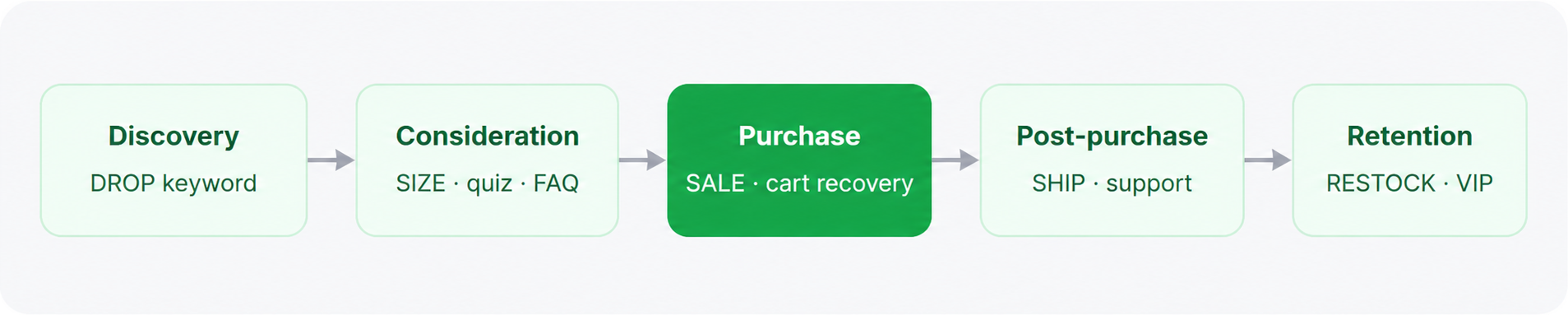
1. Discovery: product drops and launches
End your launch Reel with "Comment DROP for the link." Every commenter instantly gets the product page, while the comments themselves push the post further in the algorithm. Automate: keyword → product link → early-access invite. Keep human: nothing.
2. Consideration: sizing, FAQs and product picks
Answer "what size am I?", "is it in stock?", and "which one is right for me?" instantly. A short quiz flow — two or three questions in the DM — can route shoppers to the right product and collect preference data you own. Automate: size guides, FAQ replies, quiz-based recommendations. Keep human: complex pre-sale questions.
3. Purchase: discount codes and checkout
Deliver a code on a keyword ("Comment SALE for 10% off"), send the checkout link, and follow up once inside the 24-hour window if they don't complete. Automate: code delivery, checkout link, one cart-recovery nudge. Keep human: payment problems.
4. Post-purchase: order status and support deflection
"Where's my order?" is the single most repeated DM a store gets. A SHIP keyword that returns the tracking link deflects most support volume instantly — with a "reply AGENT for a human" escape hatch. Automate: tracking, returns info, common policies. Keep human: complaints and exceptions.
5. Retention: restocks, VIPs and reviews
Let shoppers join a back-in-stock waitlist by replying RESTOCK, invite repeat buyers into a VIP segment for early drops, and ask happy customers for a review or UGC a few days after delivery. Automate: waitlists, VIP invites, review asks. Keep human: influencer and creator relationships.
What you can automate, at a glance
| Goal | Keyword | What the DM does |
|---|---|---|
| Launch a product | DROP | Sends the product link + early-access invite |
| Deliver a discount | SALE, DISCOUNT | Sends the code + checkout link |
| Recover a cart | (automatic follow-up) | Reminds within 24 hours with the cart link |
| Answer shipping questions | SHIP | Sends the tracking link, offers a human |
| Confirm a COD order | (automatic prompt) | Asks the buyer to confirm before you ship |
| Fill a restock waitlist | RESTOCK | Adds them to the alert list, notifies when live |
| Help with sizing | SIZE | Sends the size guide or starts a quick quiz |
Copy-paste DM templates for e-commerce
Swap in your links, keep messages short, and lead with what the shopper asked for. Each template pairs a trigger with a ready-to-send message and a reason it works.
Product drop (keyword: DROP)
Hey! 🔥 The new {{product}} just dropped.
Shop before it sells out 👉 {{link}}

Want first access next time? Reply "VIP" and you're on the list.
Why it works: instant gratification at peak hype, plus a one-line path into your VIP segment.
Discount delivery (keyword: SALE)
Here's your code 🎁 SAVE10 for 10% off
Shop now: {{link}}

Code expires tonight, so don't sleep on it 😉
Why it works: the code lands in a private channel with honest urgency attached.
Abandoned checkout follow-up (within the 24-hour window)
You left {{product}} in your cart 🛒
Finish checkout here: {{cart_link}}

Use COMEBACK10 for 10% off, valid till midnight.
Why it works: one timely, friendly nudge inside the window recovers buyers email can't reach in time.
Order status (keyword: SHIP)
Track your order here 📦 {{tracking_link}}

Anything else? Reply "AGENT" and a human will jump in.
Why it works: deflects your most repetitive support DM while keeping a clear path to a person.
COD confirmation (automatic prompt)
Quick check on your COD order for {{product}} 📦
Reply "CONFIRM" to lock it in and we'll ship today.

Changed your mind? Reply "CANCEL" — no worries.
Why it works: a one-tap confirmation cuts fake and abandoned COD orders before they cost you a shipment.
Back in stock (keyword: RESTOCK)
Good news, {{product}} is BACK ✅
Grab it here: {{link}}

Sizes are limited. Reply "SIZE" if you want help picking.
Why it works: a waitlist turns sold-out frustration into a guaranteed second chance at the sale.
Connecting Instagram DMs to your store stack
DM automation gets dramatically more useful when it talks to the rest of your stack.
- Shopify or WooCommerce: pull product links, live inventory and order status into flows, fire the right tracking link on a SHIP keyword, and pause restock or drop automations automatically when inventory hits zero.
- Email and SMS (Klaviyo, Mailchimp): capture an email inside the DM ("Want the code by email too?") so nurture continues after Instagram's 24-hour window closes. The DM gets the first sale; the list gets the repeat ones.
- Order management and tracking: sync fulfillment status so a "where's my order?" DM returns a real, live tracking link instead of a canned reply — the single biggest support-deflection win for a store.
- Attribution: give every flow its own UTM-tagged link or unique discount code. That's how you prove which Reel, story, or keyword actually drove revenue.
If a comparison helps you choose a tool for this, see LinktoDM vs ManyChat, vs CreatorFlow, and vs LinkDM.
Click-to-DM ads: turning paid traffic into conversations
Comment-to-DM works on your organic posts and Reels. Click-to-DM ads — what Meta calls ads that click to message — do the same thing for paid traffic. Instead of sending a tap to a landing page, the ad's "Send message" button opens an Instagram Direct thread, and your automation greets the shopper instantly.
For e-commerce, this is often the highest-converting paid format, because the shopper never leaves the app and never waits. The flow looks like this:
- A shopper sees your ad on Instagram (Feed, Reels, Stories, or Explore).
- They tap Send message, and a Direct thread opens with a prefilled message.
- Your tool detects the new thread and runs the same keyword flow you use organically — product link, code, quiz, or COD confirmation.
- Every reply restarts the 24-hour window, so the conversation can continue compliantly.

The catch: a click-to-DM ad with no automation behind it is just a slower email form. The conversion advantage comes entirely from answering in seconds, which only a connected tool delivers at ad volume.
Selling to Indian shoppers: COD confirmation and WhatsApp hand-off
For Indian D2C brands, two realities shape how DMs should work: cash on delivery still drives a large share of orders, and shoppers live across Instagram and WhatsApp. DM automation can address both.
- COD confirmation in the DM. When a shopper places a COD order, an automated prompt ("Reply CONFIRM to lock it in") verifies intent before you ship. That one step cuts fake and abandoned COD orders, which quietly eat margin for Indian stores.
- Instagram for discovery, WhatsApp for the long tail. Instagram wins the moment of discovery, when the shopper is already in-app watching your Reel. WhatsApp is stronger for longer post-purchase threads and opt-in updates. Capture the first reply on Instagram, then move repeat communication to WhatsApp, email, or SMS.
- Pricing that fits the market. Flat INR pricing keeps costs predictable during festive launches and sale spikes, instead of bills that balloon with message volume. LinktoDM starts at ₹699/month with a free tier to test flows.
Realistic benchmarks (and the stats to ignore)
This niche is full of recycled numbers with no source. Here's the honest picture.
| Claim you'll see | Reality |
|---|---|
| "DMs get 80–90% open rates" | Unverified vendor claim. Instagram doesn't expose a standard open-rate metric, and no public study backs it. |
| "3–5x more conversions than manual replies" | Vendor-reported, no transparent methodology. Treat as marketing, not data. |
| Cart abandonment rate | 70.22% average, per the Baymard Institute's meta-analysis of 50 studies. That's the size of the recovery opportunity. |
| Abandoned-cart recovery flows | Klaviyo's benchmark of 143,000+ flows found they drive the highest revenue per recipient ($3.65 average) and a 3.33% conversion rate. That's email data, but it shows why the same play in DMs — faster and closer to the moment — is worth running. |
| "Send 5,000 DMs an hour" | Not compliant. Real tools queue to roughly 200 automated DMs per hour per account. |
Sources: Baymard Institute and Klaviyo, accessed June 2026. Email benchmarks are shown for honest context; rigorous public DM-specific benchmarks don't yet exist.
What to actually track: replies per trigger, link clicks, and orders or revenue per flow (via UTM links and unique codes). A weekly check — triggers fired, clicks, orders — tells you which flow to improve next. Judge automation by recovered carts and tracked orders, not vanity stats.
What we see across LinktoDM stores
Third-party email benchmarks set the stage, but the clearest signal comes from watching real stores run these flows. A few patterns repeat across brands on LinktoDM.
Speed is the whole game. Keyword replies fire within a couple of seconds of the comment, while the shopper is still inside the app watching the Reel. That timing — not the wording of the template — is what separates a recovered sale from a cold lead hours later.
One keyword, mapped across the funnel, beats ten one-off "comment LINK" posts. The stores that treat DMs as a channel, not a trick, are the ones that see compounding results.
A home-fragrance brand's launch, start to finish
Take a representative example: a home-fragrance D2C brand with a modest following ran a single DROP keyword on a launch Reel instead of the usual "link in bio." Here's the shape of a well-built launch flow, stage by stage:
- Discovery: the Reel's comments became the trigger — every "DROP" got the product link in seconds, and the comment volume pushed the Reel further in the algorithm.
- Consideration: a two-question scent quiz in the DM routed shoppers to the right product and captured preference data the brand now owns.
- Recovery: a single COMEBACK10 nudge inside the 24-hour window pulled back carts that email would have reached too late.
- Retention: a RESTOCK waitlist turned the inevitable sold-out moment into a ready list for the next drop.
The takeaway isn't a magic multiplier. It's that one keyword, answered instantly and mapped across the funnel, outperformed months of manual replies — because every hand-raise got a response at the exact moment intent was highest.
Staying within Instagram's rules (2026)
DM automation is only an asset if it follows Meta's messaging rules. The essentials for stores:
- The 24-hour window. You can send standard messages for 24 hours after a shopper interacts (DM, story reply, or an action button they tap). The window resets each time they reply. A plain comment allows one automated reply.
- No cold DMs and no broadcasts. You can only message people who engaged first. There's no compliant way to blast your follower list on Instagram — that's what your email and SMS lists are for.
- Human replies beyond 24 hours. The HUMAN_AGENT tag lets a real person respond for up to 7 days — it cannot be used for automated or promotional messages.
- Message tags are changing in 2026. Meta is retiring the POST_PURCHASE_UPDATE, CONFIRMED_EVENT_UPDATE and ACCOUNT_UPDATE tags on April 27, 2026 (per Meta's changelog). Order and shipping flows that relied on them must migrate to Utility Templates, the Marketing Messages API, or One-Time Notifications — or run inside the 24-hour window. Use a tool that keeps up with the official API.
- Business or Creator account only, connected through Meta's official authorization — never password-sharing tools.
- Always give an opt-out. Honor "STOP" and keep messages relevant to what the shopper asked for.
Common mistakes e-commerce brands make
- Treating it as one trick — "comment LINK" and nothing else
- Dropping a bare link with no context
- Never capturing email or SMS before the window closes
- Support flows with no path to a human
- Restock or drop flows running against zero inventory
- Untested checkout links and "unlimited DMs" tools
- Map one flow to each funnel stage
- Lead with what they asked for, then the link
- Offer the code by email too — build the list
- Add a "reply AGENT" escape hatch everywhere
- Sync inventory so flows pause when stock runs out
- Test every link from a second account first
Set it up in 4 steps
- Switch to a professional account. Settings → Account type → Business. It's free — Instagram's Help Center walks through it.
- Connect your tool. Click "Connect Instagram" and approve through Meta's official screen.
- Start with two flows: a DROP keyword on your next launch and a SHIP keyword for order tracking. One drives revenue, one saves support time — you'll feel both in week one.
- Test, then turn it on. Comment the keyword from another account, check the DM and the link, activate.
Want the detailed walkthrough with screenshots? Follow our full step-by-step auto DM setup guide.
Frequently Asked Questions
Is Instagram DM automation safe for e-commerce brands?
Can you sell products directly through Instagram DMs?
Does Instagram DM automation work with Shopify or WooCommerce?
Can I recover abandoned carts through Instagram DMs?
What is the Instagram 24-hour messaging rule?
How do click-to-DM ads work for e-commerce?
What replaces the POST_PURCHASE_UPDATE tag after April 2026?
Can I automate COD confirmation through Instagram DMs?
What's the difference between Instagram and WhatsApp DM automation for stores?
Can I DM my followers about a sale?
How many DMs can a store send per hour?
Does Instagram DM automation work for a brand new account with few followers?
How fast does an automated DM reply actually send?
Can DM automation handle customer support questions?
Do automated DMs hurt the customer experience?
Can I run back-in-stock alerts through Instagram DMs?
Does comment-to-DM work on Reels and ads?
Do I need a Meta-verified tool to stay compliant?
How much does Instagram DM automation cost for a store?
Related reading
- Instagram DM automation: the complete guide
- How to set up auto DM on Instagram (step by step)
- Is it safe to auto DM on Instagram?
- LinktoDM vs ManyChat
- LinktoDM vs CreatorFlow
Disclaimer & sources
Disclaimer: Instagram and Meta are trademarks of their respective owners. LinktoDM is an independent tool built on Meta's official Instagram Graph API and is not affiliated with or endorsed by Meta beyond the Business Partner program. Shopify, WooCommerce, Klaviyo, Mailchimp, ManyChat, CreatorFlow, and LinkDM are trademarks of their respective owners. Platform policies and limits can change, so always check Instagram's current terms. Results vary by store, niche, and usage; benchmark figures cited are from third-party studies of email flows and are shown for context, not as DM performance guarantees.
Sources: Meta Instagram Platform documentation, Meta Send API documentation, Meta Messenger Platform changelog, Meta ads that click to message, Baymard Institute cart abandonment statistics, Klaviyo Abandoned Cart Benchmark Report, and a Facebook-commissioned Instagram shopping study (all accessed June 2026).

'%3e%3cpath%20d='M14.8156%200H1.18125C0.528125%200%200%200.515625%200%201.15313V14.8438C0%2015.4813%200.528125%2016%201.18125%2016H14.8156C15.4688%2016%2016%2015.4813%2016%2014.8469V1.15313C16%200.515625%2015.4688%200%2014.8156%200ZM4.74687%2013.6344H2.37188V5.99687H4.74687V13.6344ZM3.55938%204.95625C2.79688%204.95625%202.18125%204.34062%202.18125%203.58125C2.18125%202.82188%202.79688%202.20625%203.55938%202.20625C4.31875%202.20625%204.93437%202.82188%204.93437%203.58125C4.93437%204.3375%204.31875%204.95625%203.55938%204.95625ZM13.6344%2013.6344H11.2625V9.92188C11.2625%209.0375%2011.2469%207.89687%2010.0281%207.89687C8.79375%207.89687%208.60625%208.8625%208.60625%209.85938V13.6344H6.2375V5.99687H8.5125V7.04063H8.54375C8.85938%206.44063%209.63438%205.80625%2010.7875%205.80625C13.1906%205.80625%2013.6344%207.3875%2013.6344%209.44375V13.6344Z'%20fill='%23B1B1B1'/%3e%3c/g%3e%3cdefs%3e%3cclipPath%20id='clip0_6304_15414'%3e%3crect%20width='16'%20height='16'%20fill='white'/%3e%3c/clipPath%3e%3c/defs%3e%3c/svg%3e)

