




Trying to turn Instagram posts into real business results can feel like chasing shadows when you do not have clear targets. For influencers and digital marketers across the United States and Canada, setting SMART objectives along with the right KPIs is what drives growth instead of guesswork. This guide helps you focus on strategies backed by measurable data, showing how automation and aligned tracking bring sustainable results you can see and trust.
Quick Summary
| Key Insight | Explanation |
|---|---|
| 1. Define Clear Campaign Objectives | Establish specific, measurable objectives to guide your campaign efforts effectively. This ensures targeted growth rather than random activities. |
| 2. Choose Relevant KPIs | Select 2-4 key performance indicators directly aligned with your objectives to accurately measure success and avoid confusion. |
| 3. Connect Tools for Tracking | Utilize automation and analytics tools to create a connected system for real-time tracking of metrics and engagement in your campaigns. |
| 4. Analyze Engagement and Conversions | Regularly evaluate engagement metrics and link them to actual conversions to gain insight into what drives business results. |
| 5. Verify and Optimize ROI | Double-check your ROI calculations to ensure accuracy, then use that data to refine future content and optimize your spending effectively. |
Step 1: Define campaign objectives and KPIs
You’re about to set the foundation for everything that follows. Clear campaign objectives and key performance indicators (KPIs) are what separate campaigns that deliver results from those that just generate noise. Without them, you’re essentially flying blind, hoping your Instagram efforts translate into real growth.
Start by identifying what you actually want to achieve. Setting SMART objectives means your goals should be Specific, Measurable, Achievable, Relevant, and Time-bound. Don’t just say “grow my audience.” Instead, say “gain 5,000 engaged followers in 90 days who interact with my product content.”
Your campaign objectives typically fall into one of these categories:
- Brand awareness: You want people to know who you are
- Engagement: You want comments, likes, shares, and real conversations
- Lead generation: You want people’s contact information or interest signals
- Sales: You want direct conversions or revenue
Each objective requires different KPIs to measure success. Brand awareness campaigns track impressions and reach. Engagement-focused campaigns monitor engagement rates and comment sentiment. Lead generation campaigns measure click-through rates and form submissions. Sales campaigns focus on conversion rates and return on ad spend (ROAS).
Here’s a quick reference comparing common Instagram campaign objectives and their most actionable KPIs:
| Campaign Objective | Key KPI Example | KPI Business Impact |
|---|---|---|
| Brand Awareness | Impressions, Reach | Increases audience visibility |
| Engagement | Engagement Rate, Shares | Builds brand loyalty, feedback |
| Lead Generation | Click-Through Rate, Forms | Drives contact list growth |
| Sales | Conversion Rate, ROAS | Direct revenue and sales growth |
Here’s the critical part: your KPIs must align directly with your objectives. If you’re chasing brand awareness but measuring conversions, you’re measuring the wrong thing. Pick 2-4 KPIs maximum per campaign—too many metrics create confusion and waste your time.
Vague objectives create vague results. Specific, measurable targets drive accountable growth and real ROI.
Consider what you can realistically track. Instagram gives you access to impressions, reach, saves, shares, profile visits, website clicks, and follower growth. Use tools like LinktoDM to automate engagement tracking and monitor how your automated interactions affect your KPIs in real time. This removes guesswork and shows exactly which tactics move your numbers.
Write your objectives down and share them with anyone working on the campaign. Misalignment kills campaigns faster than bad content.
Pro tip: Set your baseline metrics before the campaign launches. Knowing your starting point makes it obvious what actually changed because of your efforts, not because of random fluctuations.
Step 2: Connect automation and tracking tools
Now that your objectives and KPIs are locked in, you need the right infrastructure to actually measure them. Without proper tools, tracking your ROI becomes a manual nightmare that drains time and introduces human error. The goal here is to create a connected system where your automation engine and analytics work together seamlessly.

Start by choosing your core tools. You’ll need an automation platform that handles your Instagram interactions and a tracking system that captures the results. Social media analytics tools like Hootsuite Insights and Google Analytics consolidate data across platforms, track conversions, and show campaign impact in real time. This integration removes the friction between what you’re doing and what you’re measuring.
For clarity, here’s how core automation and analytics tools differ in functionality and impact:
| Tool Type | Main Function | Strategic Benefit |
|---|---|---|
| Automation Platform | Manage Instagram engagement | Saves manual effort |
| Tracking System | Capture and analyze metrics | Enables ROI validation |
| Analytics Dashboard | Real-time performance review | Supports quick optimizations |
Here’s what your connected system should do:
- Automatically log every interaction your automation tools create
- Track which followers came from automation versus organic discovery
- Measure conversion paths from Instagram click to actual sale or lead
- Provide real-time dashboards so you see results as they happen
- Flag anomalies or drops in performance immediately
When selecting tools, prioritize ones that talk to each other. Platforms like LinktoDM handle automated engagement while feeding data into your analytics dashboard. This eliminates manual data entry and the gaps where metrics get lost or misattributed.
Set up your tracking before you launch any campaigns. Configure UTM parameters on your links so you know exactly which posts drive clicks. Enable conversion tracking in Instagram and your website analytics. Test the data flow to confirm metrics are actually being recorded.
Connected tools transform guesswork into data. Real-time visibility means you can optimize faster and prove ROI to yourself and anyone funding your growth.
Check your dashboards daily during the first week of a campaign. You’ll spot setup issues quickly and understand how data actually flows through your system. This early feedback loop prevents surprises later.
Pro tip: Automate your reporting by setting up weekly snapshots that pull your KPI data automatically. This saves you from manual spreadsheet updates and creates a clean historical record that makes ROI trends obvious over time.
Step 3: Analyze Instagram engagement and conversions
You’ve set up your tools and campaigns are running. Now comes the part that actually reveals whether your efforts are working. Analyzing engagement and conversions transforms raw data into actionable insights that show what’s moving your business forward.
Start by understanding what you’re measuring. Instagram analytics reveal account performance through metrics like reach, impressions, and engagement rate, helping you understand which content resonates and when audiences interact most. But engagement alone tells an incomplete story. You need to connect that engagement to actual conversions—sales, leads, sign-ups, or whatever your objective is.
Focus on these key metrics:
- Engagement rate: Comments, likes, shares, and saves divided by your audience size
- Click-through rate: How many people clicked your link versus how many saw the post
- Conversion rate: How many clicks turned into actual desired actions
- Cost per conversion: What you spent to get one genuine result
- Loyalty indicators: Repeat interactions from the same followers, showing genuine connection
The research shows that engagement quality and follower loyalty matter more than raw follower count when predicting revenue impact. A post with 100 comments from genuine fans drives more business value than one with 10,000 likes from random accounts. Track which followers take repeated actions and which content types generate follow-through behavior.
Connect your Instagram data to your website and sales data. If someone clicked your bio link, you should be able to track them to a purchase or lead form. This attribution chain proves ROI clearly. Without it, you’re guessing whether Instagram actually drives business results.
Quality engagement that converts beats vanity metrics every time. One loyal customer is worth infinitely more than a thousand passive observers.
Review your data weekly, not daily. Daily fluctuations create noise and cloud real trends. Weekly reviews show you patterns—which post types, topics, or posting times actually drive results.
Pro tip: Create a simple comparison table tracking your top 5 performing posts alongside your worst 5. Look for patterns in topic, length, call-to-action style, and posting time. You’ll quickly spot what your audience actually wants, saving you from creating content that just looks good but doesn’t convert.
Step 4: Verify and optimize ROI results
You’ve analyzed your data. Now it’s time to verify that your ROI calculations are actually accurate and then use those findings to improve results. This step separates marketers who get lucky from those who build repeatable, profitable systems.
Start by double-checking your ROI math. The basic formula is straightforward: (revenue generated minus total spend) divided by total spend, multiplied by 100. But verification means confirming every number in that equation. Did you count all your expenses? Are you attributing revenue correctly to Instagram activity?
Here’s what needs verification:
- All costs associated with the campaign, including tools, content creation, and paid promotion
- Revenue or value attributed to Instagram traffic, not just tracked clicks
- Time period alignment between campaign duration and results measurement
- Exclusion of external factors that might skew numbers
To optimize social media ROI, use data to identify high-performing content and campaigns, then focus resources there. Tools that integrate data across channels make this identification process automatic and reliable. Stop spending on what doesn’t work. Double down on what does.
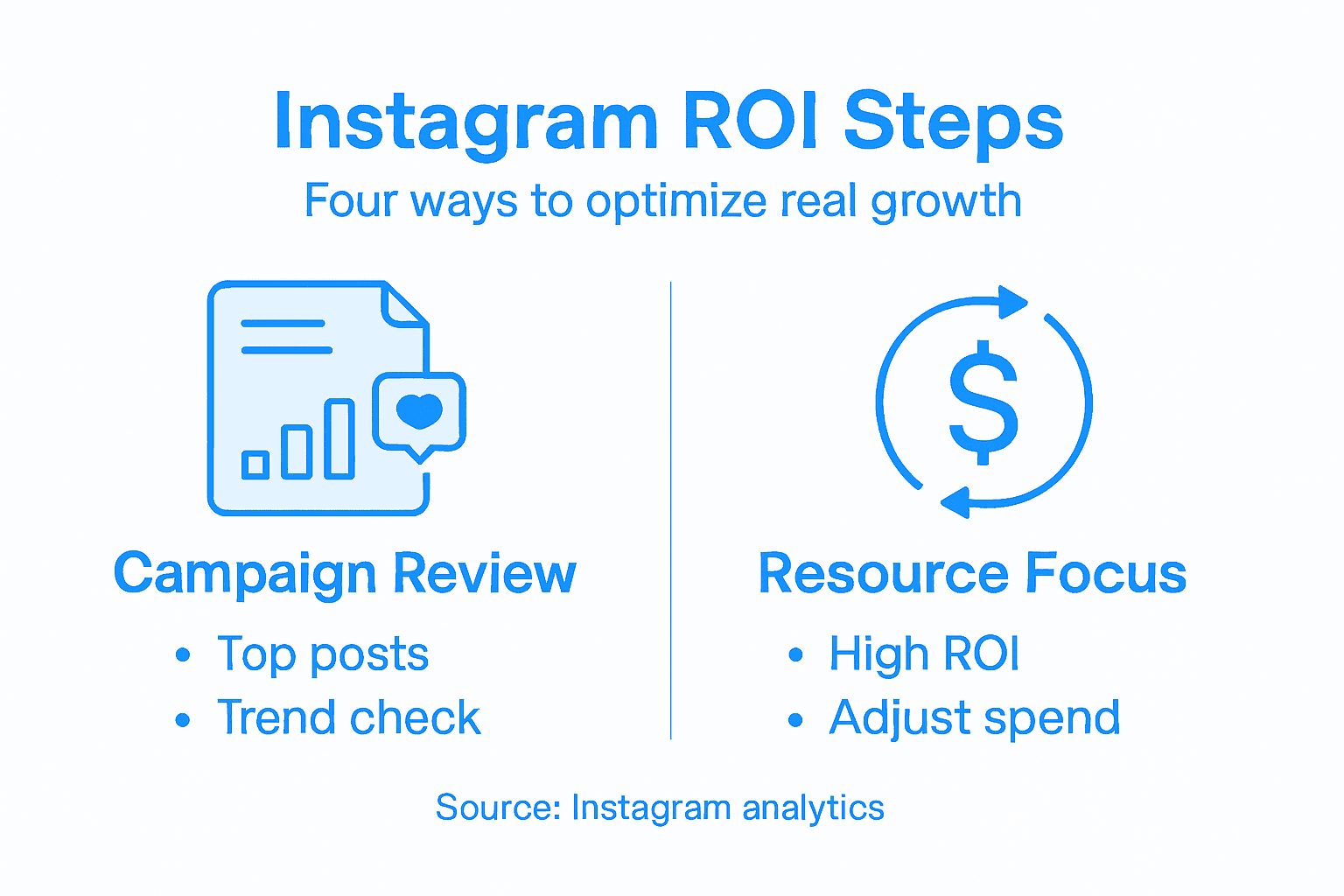
Once verified, create a simple optimization framework. Look at your top three performing posts and campaigns. What do they have in common? Topic, format, posting time, call-to-action style, or audience segment? Apply those patterns to your next 10 pieces of content. Measure the results.
Then look at your worst performers. Did they fail because of audience mismatch, poor timing, or weak messaging? Understanding failure patterns prevents repeating them.
Verification prevents you from celebrating fake wins. Optimization prevents you from celebrating past wins forever while the market shifts.
Adjust your spending allocation quarterly or whenever you gather enough data to spot trends. If one campaign type delivers 5x ROI while another barely breaks even, shift your budget accordingly. This continuous refinement compounds over time.
Document your findings so you and anyone else working on your account can learn from what worked. This becomes your playbook for future campaigns.
Pro tip: Create a simple ROI scorecard that tracks each campaign’s actual return next to your original projection. Over time, your projections become more accurate, which means better planning and fewer surprises when campaigns launch.
Unlock Real Instagram Growth with Smart Automation and Tracking
Measuring ROI on Instagram can feel overwhelming when trying to connect engagement with real business results. This article highlights the challenge of setting clear objectives, tracking meaningful KPIs, and verifying conversions to avoid guessing games. If your goal is to boost genuine follower engagement, generate leads, and optimize your campaigns for profitable growth, relying on manual tracking can hold you back.
LinktoDM offers a powerful solution tailored for creators and marketers who want to automate Instagram interactions while capturing precise data to measure impact. With its AI-powered auto-replies, comment replies, story interaction automation, and advanced click tracking, you can streamline engagement without sacrificing the quality insights needed to verify and optimize ROI. Imagine confidently growing your audience and sales because every action is backed by real-time analytics and scalable automation.
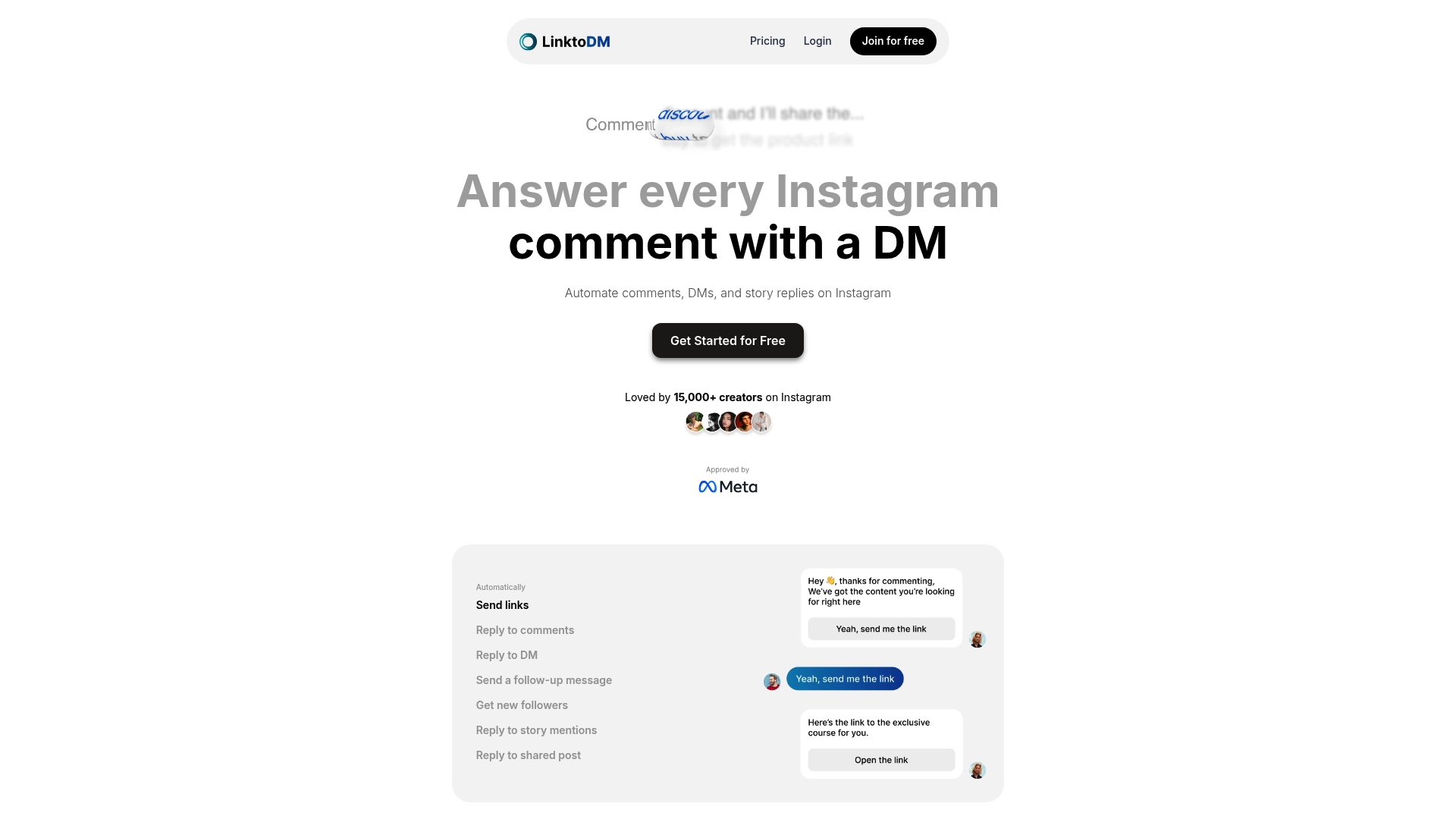
Accelerate your Instagram growth strategy by integrating automation tools that speak the same language as your KPIs. Experience how LinktoDM transforms follower engagement into measurable business value. Start optimizing your campaigns today with features designed to help you set clear objectives, track conversions, and achieve real growth. Visit LinktoDM to get started and turn your Instagram efforts into real results.
Frequently Asked Questions
How can I set clear campaign objectives for measuring ROI on Instagram?
To set clear campaign objectives, use the SMART framework: ensure your goals are Specific, Measurable, Achievable, Relevant, and Time-bound. For example, aim to “gain 5,000 engaged followers in 90 days” instead of just stating you want to grow your audience.
What are the key performance indicators (KPIs) I should track for Instagram campaigns?
Key performance indicators (KPIs) to track include engagement rate, click-through rate, conversion rate, and cost per conversion. For a lead generation campaign, for instance, measure the click-through rate to evaluate how many users take action based on your content.
How can I connect automation and tracking tools to measure my Instagram ROI effectively?
Connect automation platforms with analytics tools to create a seamless tracking system. Ensure your automation tools log interactions and your tracking tools capture results in real time, enabling you to analyze data without manual effort.
What metrics should I analyze to confirm that my Instagram efforts are leading to conversions?
Analyze metrics such as engagement rate, click-through rate, and conversion rate to understand what drives user actions. For instance, if your click-through rate is consistently lower than expected, reassess your call-to-action or content strategy to improve results.
How can I verify my ROI calculations and optimize future Instagram campaigns?
To verify your ROI calculations, check all costs associated with the campaign and confirm you’re attributing revenue correctly. Once confirmed, create an optimization framework by identifying patterns in your successful posts and applying those insights to future content.
Recommended
- Why Analyze Instagram Interactions for Growth Impact
- 7 Key Metrics to Track for Instagram Growth
- Why Measure Conversion on Instagram: Complete Guide
- Analytics for Instagram Marketers: Boosting Growth
- Why Invest in Music Videos for Artist Growth | Music Video Marketplace Blog
- Accompagnement Marketing B2B - Katalyx

'%3e%3cpath%20d='M14.8156%200H1.18125C0.528125%200%200%200.515625%200%201.15313V14.8438C0%2015.4813%200.528125%2016%201.18125%2016H14.8156C15.4688%2016%2016%2015.4813%2016%2014.8469V1.15313C16%200.515625%2015.4688%200%2014.8156%200ZM4.74687%2013.6344H2.37188V5.99687H4.74687V13.6344ZM3.55938%204.95625C2.79688%204.95625%202.18125%204.34062%202.18125%203.58125C2.18125%202.82188%202.79688%202.20625%203.55938%202.20625C4.31875%202.20625%204.93437%202.82188%204.93437%203.58125C4.93437%204.3375%204.31875%204.95625%203.55938%204.95625ZM13.6344%2013.6344H11.2625V9.92188C11.2625%209.0375%2011.2469%207.89687%2010.0281%207.89687C8.79375%207.89687%208.60625%208.8625%208.60625%209.85938V13.6344H6.2375V5.99687H8.5125V7.04063H8.54375C8.85938%206.44063%209.63438%205.80625%2010.7875%205.80625C13.1906%205.80625%2013.6344%207.3875%2013.6344%209.44375V13.6344Z'%20fill='%23B1B1B1'/%3e%3c/g%3e%3cdefs%3e%3cclipPath%20id='clip0_6304_15414'%3e%3crect%20width='16'%20height='16'%20fill='white'/%3e%3c/clipPath%3e%3c/defs%3e%3c/svg%3e)

