



Most brands waste resources by chasing generic audiences instead of focusing on real connections. Recent studies show that marketers who analyze digital behavior and tailor strategies see over 30 percent higher engagement. For any american business aiming to stand out, knowing exactly who you are speaking to is not just helpful, it is crucial. This guide lays out practical steps to define your audience, build consistency across platforms, and use data-driven tools for marketing that feels both personal and effective.
Quick Summary
| Key Point | Explanation |
|---|---|
| 1. Understand Your Core Audience | Define demographic and psychographic traits of your audience to tailor marketing efforts effectively. |
| 2. Customize Platform Engagement Strategies | Adapt communication styles and content types for each platform to maximize audience interaction. |
| 3. Leverage Automation Tools Wisely | Use automation to streamline marketing tasks while maintaining individual audience engagement preferences. |
| 4. Establish Clear Metrics | Set measurable goals and track KPIs to assess marketing effectiveness and adapt strategies accordingly. |
| 5. Continuously Optimize and Test | Regularly review performance data and adjust strategies based on insights from different platforms. |
Step 1: Define Core Audience and Brand Objectives
Your marketing plan will succeed or fail based on how clearly you understand your core audience and strategic objectives. According to research from Sun AC, analyzing digital platform interaction data provides critical insights into who actually engages with your communication and their fundamental goals.
To start defining your core audience, map out detailed demographic and psychographic profiles that go beyond basic age and location. Examine your current audience data including engagement rates, interaction patterns, content preferences, and online behaviors. Look for consistent themes and segments that represent your most active and valuable followers. This isn’t about guessing who might like your brand. It’s about understanding who genuinely connects with your message.
As Ngo Viet Liem research highlights, your brand core should combine clear values and promises that appeal directly to this specific audience. Your objectives must align precisely with both your audience’s needs and your brand’s unique capabilities. Ask yourself: What specific problem do we solve? What makes our approach different? How can we communicate our unique value consistently?
Warning: Avoid the common mistake of creating generic audience personas. Your profiles should be so specific that they feel like real people with genuine motivations and challenges. Each detail matters.
Next, you’ll translate these audience insights and brand objectives into a concrete strategic framework that guides all your marketing efforts.
Step 2: Map Multi-Platform Engagement Strategies
Successful marketing requires a nuanced approach to engaging audiences across different platforms. Research from Link Springer demonstrates that task-based and experiential customer engagement strategies can dramatically improve marketing outcomes when tailored specifically to each platform’s unique characteristics.
To map your multi-platform engagement strategy, start by analyzing your audience’s behavior on each platform. Instagram users might prefer visual storytelling, while LinkedIn audiences expect more professional content. Track metrics like engagement rates, content interactions, and conversion patterns unique to each platform. Create platform-specific content pillars that align with audience expectations while maintaining a consistent brand voice. This means adapting your messaging style, visual design, and interaction approach without losing your core brand identity.
As highlighted by Link Springer’s sustainability communication research, platform-specific communication strategies are crucial. Don’t just copy-paste content across channels. Develop a strategic matrix that outlines different content types, posting frequencies, and interaction styles for each platform. For Instagram, this might mean more dynamic visual stories. For Twitter, more concise, sharply worded updates. For LinkedIn, more in-depth professional insights.
Warning: Avoid the trap of treating all platforms identically. Each digital space has its own unwritten rules, audience expectations, and engagement dynamics.
Next, you’ll develop a content calendar that strategically implements these multi-platform insights, ensuring consistent yet platform optimized communication.
Step 3: Integrate Automation Tools for Consistency
Automation tools are the secret weapon for maintaining a seamless marketing strategy across multiple platforms. According to ArXiv, computational linguistics and analytics can dramatically enhance information engagement by precisely predicting and modifying user interaction patterns.
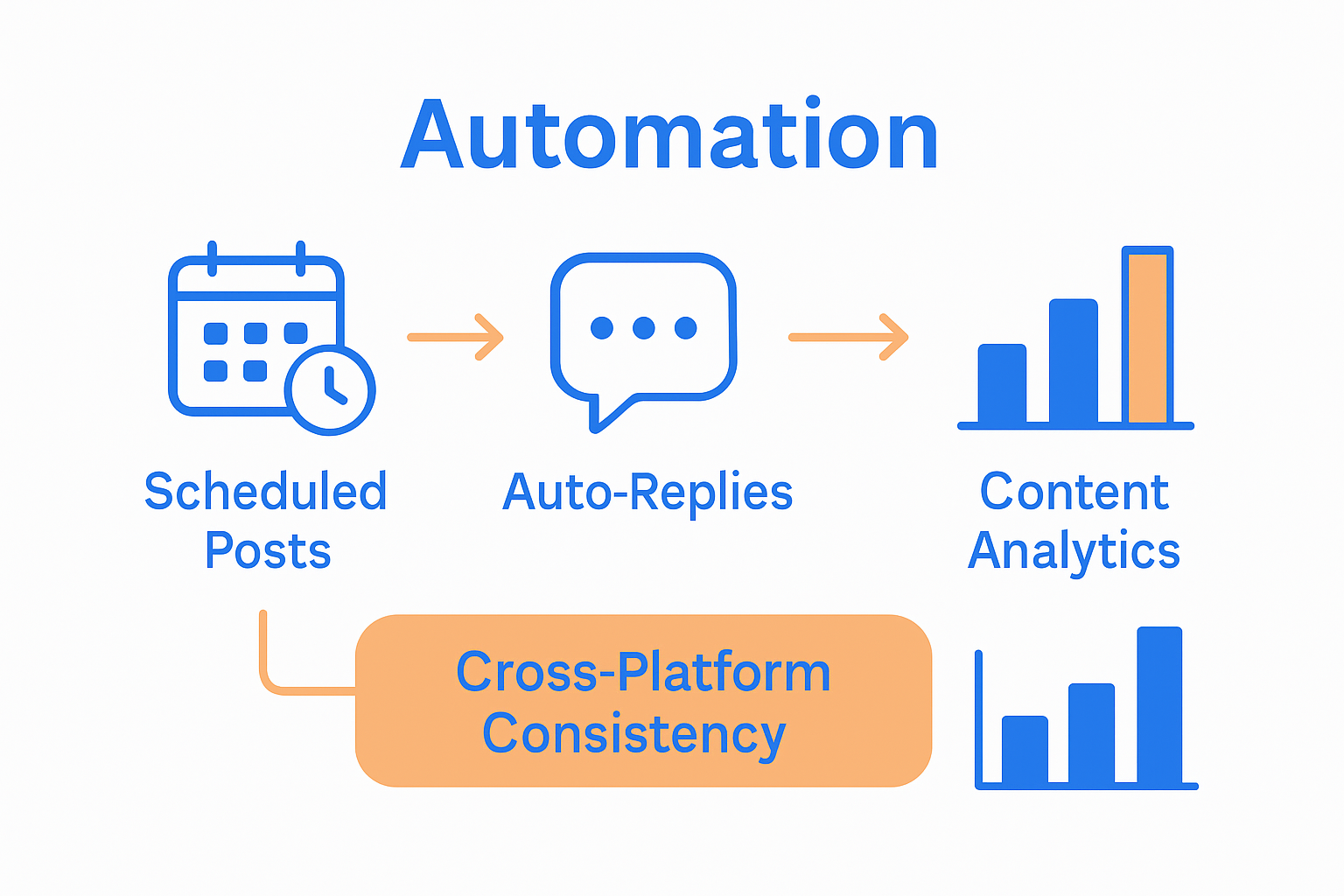
To successfully integrate automation tools, start by mapping out your content workflows and identifying repetitive tasks that can be streamlined. Focus on tools that offer cross-platform synchronization, allowing you to maintain consistent messaging while adapting to each platform’s unique requirements. Look for solutions that can schedule posts, auto-generate content variations, and track engagement metrics in real time. The goal is not to replace human creativity but to amplify it by eliminating manual administrative work.

Research from ArXiv’s DIGMN model demonstrates the power of dynamically modeling user intent to improve engagement forecasting. This means your automation strategy should be intelligent and adaptive. Choose tools that can learn from your audience’s interactions, automatically adjusting content timing, style, and frequency based on actual performance data. For Instagram, this might mean auto-scheduling stories. For LinkedIn, it could involve automatically tailoring professional content based on audience segments.
Warning: Automation is not a set-it-and-forget-it solution. Regularly review and fine-tune your tools to ensure they complement your brand voice and audience expectations.
Next, you’ll develop a comprehensive content calendar that leverages these automation insights, transforming your marketing approach from reactive to proactively strategic.
Step 4: Establish Measurable Metrics and Benchmarks
Creating a robust marketing strategy requires setting clear, quantifiable goals that track your progress and demonstrate real value. According to research from Link Springer, developing a unifying framework for customer engagement strategies is crucial for optimizing your marketing investments and understanding true performance outcomes.
To establish meaningful metrics, start by identifying key performance indicators (KPIs) that directly align with your brand objectives. These might include engagement rates, conversion percentages, audience growth, content reach, and revenue generated from specific campaigns. Break down these metrics for each platform you are targeting. For Instagram, this could mean tracking story views, profile visits, and direct message interactions. For LinkedIn, focus on post impressions, professional network growth, and lead generation metrics.
Research from ArXiv introduces the READ model, which validates engagement prediction through advanced quantitative analysis. Implement this approach by creating a comprehensive tracking system that goes beyond surface level metrics. Use AB testing to understand which content types and messaging strategies generate the most meaningful interactions.
Develop a benchmarking process that compares your performance against industry standards while also establishing your own baseline for continuous improvement.
Warning: Metrics are not just numbers. They tell a story about your audience’s behavior and your content’s effectiveness. Avoid the trap of collecting data without meaningful interpretation.
Next, you’ll learn how to translate these metrics into actionable insights that continuously refine your marketing strategy.
Step 5: Review, Test, and Optimize Across Platforms
Successful marketing requires continuous refinement and strategic adaptation across different digital platforms. Research from Link Springer emphasizes the critical need for platform-specific communication strategies that evolve through careful analysis and optimization.
To effectively review and test your marketing approach, implement a systematic quarterly review process. Start by comparing performance metrics across each platform, identifying what content resonates with different audience segments. Use A/B testing to experiment with variations in messaging, visual design, posting times, and content formats. Pay attention to nuanced differences between platforms. What works on Instagram might fall flat on LinkedIn, so develop platform-specific experimental approaches that honor each channel’s unique audience expectations and interaction patterns.
According to ArXiv’s practice mapping research, analyzing multimodal interactions provides deep insights into cross-platform communication strategies. Create a comprehensive dashboard that tracks key performance indicators, allowing you to quickly visualize trends and performance variations. Look beyond surface level metrics to understand the deeper narrative behind your engagement data. Are certain content types driving more meaningful interactions? Which messaging approaches generate genuine audience connection versus mere surface level engagement?
Warning: Optimization is not about chasing viral moments. It is about building consistent, authentic communication that genuinely connects with your target audience across multiple platforms.
Next, you will learn how to translate these insights into a dynamic, responsive marketing strategy that adapts in real time to audience preferences.
Simplify Your Multi-Platform Marketing with Smart Instagram Automation
Creating a marketing plan that thrives across every platform takes deep audience insight and consistent engagement strategies. This article highlights key challenges like tailoring content to different channels and maintaining authentic communication without losing your brand voice. With complex tasks such as managing replies, tracking metrics, and adapting content in real time, staying on top of all interactions can quickly become overwhelming.
That is where LinktoDM offers a powerful solution designed specifically for Instagram creators and influencers. Our SaaS platform automates comment replies, direct message conversations, story interactions, and follower engagement while preserving a natural and personalized touch. Leverage AI-powered auto-replies and advanced analytics to streamline tedious tasks and keep your marketing plan strong and consistent. Discover how our tools integrate seamlessly to help you accurately target your core audience and amplify engagement without manual effort.
Ready to transform your Instagram marketing efforts with intelligent automation?
Take control of your multi-platform strategy today by visiting LinktoDM and unlock customized automation features that align with the research-backed methods presented in the article. Don’t let manual management slow your growth.
 Act now and start building authentic, scalable connections with your audience.
Frequently Asked Questions
How can I define my core audience effectively?
To define your core audience, analyze your existing audience data, focusing on demographics, psychographics, and engagement patterns. Create detailed profiles that represent your most engaged followers, aiming to understand their motivations and challenges.
What strategies can I use for multi-platform engagement?
Develop a multi-platform engagement strategy by tailoring content for each platform’s unique characteristics. Analyze audience behavior and create platform-specific content that aligns with their preferences, ensuring your brand voice remains consistent across all channels.
How do I integrate automation into my marketing plan?
Integrate automation by identifying repetitive tasks that can be streamlined, such as post scheduling and content variation generation. Choose tools that allow you to maintain consistent messaging while adapting to specific platform requirements, aiming to reduce manual workload significantly within 30 days.
What metrics should I track to measure marketing effectiveness?
Focus on tracking key performance indicators (KPIs) that align with your marketing goals, such as engagement rates and conversion percentages. Establish a comprehensive tracking system that includes platform-specific metrics to provide deeper insights into your content’s performance and audience interactions.
How often should I review and optimize my marketing strategy?
Implement a quarterly review process to assess your marketing strategy’s effectiveness. Utilize A/B testing to experiment with different approaches and continually refine your tactics based on engagement trends observed over that quarter.
What is the best way to ensure my messaging connects with my audience?
Ensure your messaging resonates by consistently reviewing engagement data to identify what content performs best. Tailor your communication style to honor the unique expectations of each platform, allowing you to build authentic connections with your audience over time.

'%3e%3cpath%20d='M14.8156%200H1.18125C0.528125%200%200%200.515625%200%201.15313V14.8438C0%2015.4813%200.528125%2016%201.18125%2016H14.8156C15.4688%2016%2016%2015.4813%2016%2014.8469V1.15313C16%200.515625%2015.4688%200%2014.8156%200ZM4.74687%2013.6344H2.37188V5.99687H4.74687V13.6344ZM3.55938%204.95625C2.79688%204.95625%202.18125%204.34062%202.18125%203.58125C2.18125%202.82188%202.79688%202.20625%203.55938%202.20625C4.31875%202.20625%204.93437%202.82188%204.93437%203.58125C4.93437%204.3375%204.31875%204.95625%203.55938%204.95625ZM13.6344%2013.6344H11.2625V9.92188C11.2625%209.0375%2011.2469%207.89687%2010.0281%207.89687C8.79375%207.89687%208.60625%208.8625%208.60625%209.85938V13.6344H6.2375V5.99687H8.5125V7.04063H8.54375C8.85938%206.44063%209.63438%205.80625%2010.7875%205.80625C13.1906%205.80625%2013.6344%207.3875%2013.6344%209.44375V13.6344Z'%20fill='%23B1B1B1'/%3e%3c/g%3e%3cdefs%3e%3cclipPath%20id='clip0_6304_15414'%3e%3crect%20width='16'%20height='16'%20fill='white'/%3e%3c/clipPath%3e%3c/defs%3e%3c/svg%3e)

